
PropTech software development
that closes the transaction.
Listing platforms, transaction workflows, tenant portals, property management, and the data layer behind valuation and investment decisions. Built for the pace of a real estate deal and the paperwork behind it.
Every feature is a contract clause.
Real estate software has to respect that every transaction leaves a legal paper trail. Signed agreements, money movement, regulatory filings, and multi-party approvals. A UX shortcut that skips a required disclosure becomes a contract dispute six months later. The engineering discipline has to match that reality.
We've built listing portals, brokerage platforms, tenant experience apps, property-management backends, and institutional-grade data platforms for real-estate investors. Every project goes through a workflow review with legal and compliance before the happy path ships.
Things we've shipped
in proptech.
A sample of what we've built in this sector. We omit client names by default and share them under NDA when you want to dig into a specific engagement.
The problems property teams bring to us.
Listing and transaction platforms.
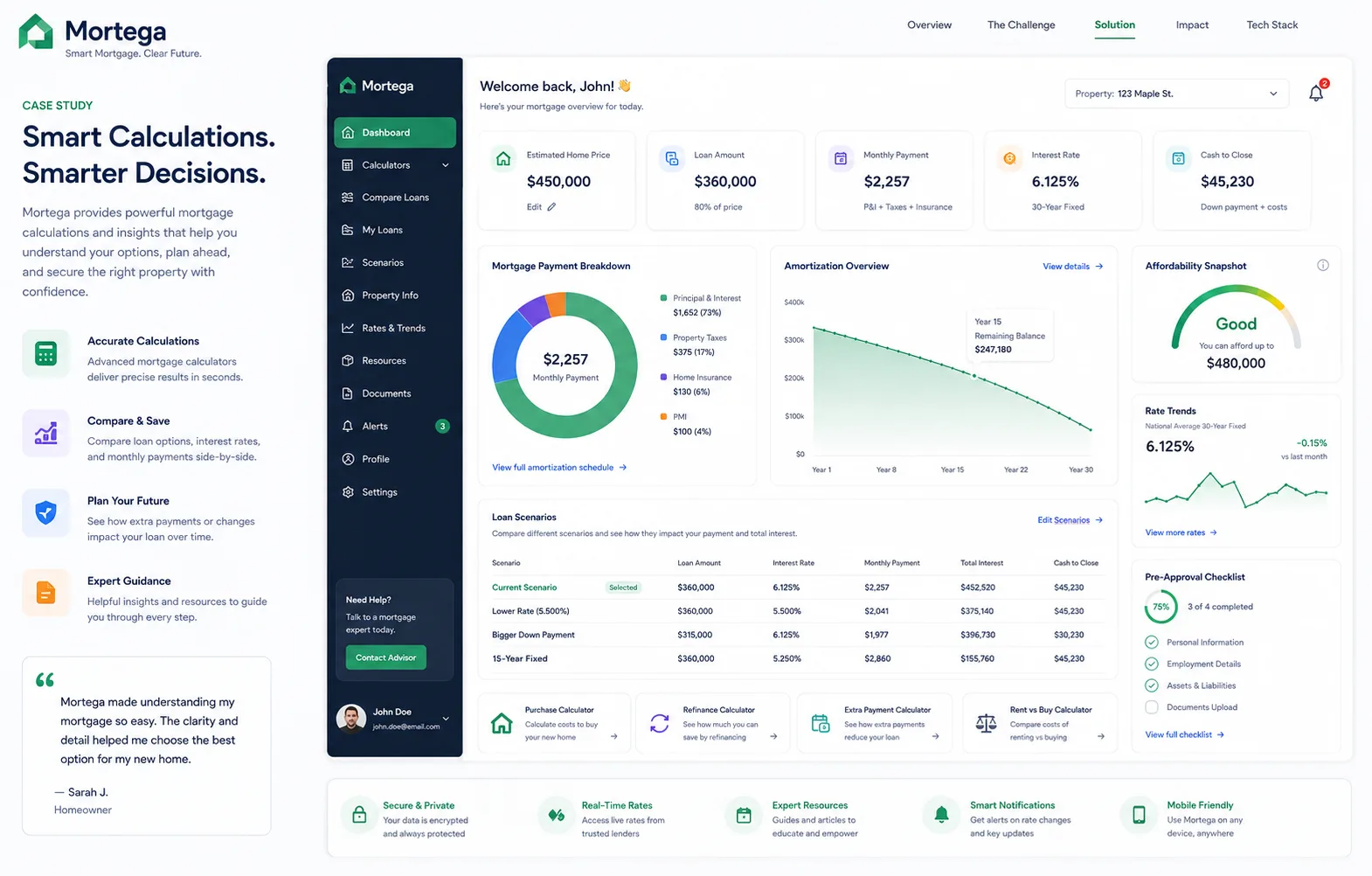
Consumer-facing search, agent tools, offer and negotiation workflows, e-signature and money movement. Built for speed without cutting the disclosures and audit trail.
Tenant and resident portals.
Rent, maintenance, communications, amenity booking. Designed for the tenant, the property manager, and the owner. Three user types in one product.
Property management backends.
Leases, accounting, maintenance workflows, vendor management. Built to replace the patchwork of spreadsheets that every portfolio grows into.
Investment and valuation platforms.
Deal pipelines, underwriting models, market data surfaces, portfolio reporting. For institutional investors, REITs, and real-estate private equity.
What we've built for property, more than once.
Consumer search and listing apps.
Fast, personalised, map-forward. Core Web Vitals green, accessibility audited, localised for every market.
Agent and broker tools.
CRM, deal rooms, commission management, compliance packets. Built with producing agents, not for them.
Tenant and property-management apps.
Web and mobile, multi-portfolio, integrated with accounting, payments, and the rest of the vendor stack.
Real-estate data platforms.
Parcels, transactions, rents, ownership. Ingestion, normalisation, de-duplication, plus the APIs and dashboards that turn records into decisions.
Three ways to work with us
in proptech.
Pick the shape that matches the commitment. Each model ships the same engineering standard. The difference is commercial and operating fit.
Dedicated teams
A cross-functional pod owning a workstream end-to-end.
Offshore development centre
A fully-managed engineering arm built in-region.
Staff augmentation
Senior engineers plugged straight into your team.
AI in real estate & proptech.
Listing copy and imagery generated from property data, key terms pulled out of leases and contracts, and tenant assistants that log and route maintenance requests.
Explore AI development“Dragonfly has been working with the team at Enigmatix Global for several years now on building out our web-based platform and APIs. One of their strengths is quickly building out a multi-disciplinary team to work on the development and delivery of features with different technical requirements. Their support has allowed us to accelerate our development work without building an internal team. They have also worked seamlessly with other third parties both during the acquisition of Dragonfly and development of our mobile app. Enigmatix Global has been instrumental in bringing our ideas to life and providing guidance to help us make the best technical decisions. I would recommend getting in touch with them if you're looking for support.”
Answers for real estate & proptech buyers.
Still wondering something? Ask an engineer
Listing and marketplace platforms, property and tenancy management, viewing and booking flows, valuation and analytics tooling, and the document and e-signature paths that carry a transaction to completion. The engineering focus is the handoffs between parties, because that is where property transactions actually stall.
Yes. Portal feeds and listing syndication, agency CRM systems, referencing and credit-check providers, and payment or deposit services. Property data arrives in inconsistent shapes from every source, so normalisation and conflict resolution get explicit design attention rather than being left to the import script.
Yes, and typically both sides of the same system. Applications and referencing, tenancy documents and signatures, maintenance requests with contractor workflow, and payment and statement views. The design problem is that the two audiences want opposite things from the same data, which is a product decision before it is an engineering one.
We staff Real estate & PropTech engagements with engineers and delivery leads who've shipped in the sector before, backed by patterns proven across 5,000+ projects. The domain literacy is learned on the ground, not looked up.
We work to tenancy law per jurisdiction, e-signature regulations, and anti-money-laundering rules. Every engagement starts with a compliance review so there's no ambiguity about which regimes apply. Every release ships with the audit trail your compliance team needs.
Yes. Most of our engagements connect to MLS, PMS, accounting back-ends, e-signature (DocuSign, Adobe Sign), and payments. We adopt your existing integration patterns rather than imposing a new one, and we write data contracts before we write integration code.
We design for transaction-grade audit trails, multi-role portals, and document-heavy workflows from day one, not as a post-launch afterthought. Performance budgets, SLO commitments, and ops runbooks are written into the statement of work.
Either. Real estate & PropTech engagements run under all three of our engagement models. Dedicated teams, offshore development centres, or embedded staff augmentation. We pick the shape that matches your operating model, not our preferred one.
Discovery typically runs two to four weeks from first call to signed statement of work. First-engineer start dates follow within another week or two. The exact timeline depends on the shape and on the clearance or onboarding your environment requires.
Let's build from here.
Thirty minutes with an engineer who builds. No sales, no drip campaign. If we're the wrong fit we'll tell you and point you somewhere better.