
Moneymaze: financial literacy for a credit union's members.
A financial education mobile app built for a credit union with Python, Django, Django REST Framework and React Native. Alongside budgeting education it runs a simulation exercise in which participants make a sequence of real-world financial decisions against a fixed income and see the consequences play out.
The challenge.
- Financial education fails when it is delivered as information: people do not change behaviour because they were told a fact about compound interest.
- The simulation exercise had to model interacting decisions — housing, transport, insurance, unexpected costs — where the lesson comes from the trade-offs rather than from any single choice.
- It runs in facilitated group sessions as well as individually, so it had to work with a room of participants moving at different speeds without a facilitator managing each one.
- It carries a member-facing institution's name, so the reliability and privacy expectations were those of a financial product rather than an educational one.
Our approach.
- Put the simulation rules in Django on the server rather than in the client, so the scenario logic is reviewable and changeable centrally and cannot be inspected or altered by a participant.
- Modelled a run as a sequence of decisions against an evolving financial state, which makes each choice's consequence traceable rather than delivered as an unexplained final score.
- Built the client in React Native so a single codebase serves both platforms, keeping a facilitated session consistent regardless of what device a participant brought.
- Kept the API stateless per decision through Django REST Framework, so a participant losing connectivity mid-session resumes rather than restarts.
- Held only what the exercise requires — simulation state, not real member financial data — because the safest way to protect sensitive data in an educational product is not to collect it.
The outcome.
- Learning comes from consequence rather than presentation: participants see how earlier decisions constrain later ones.
- Scenario content can be revised centrally without shipping an app release.
- The exercise runs in facilitated group sessions with participants at different points without co-ordination overhead.
- The app carries no real member financial data, which keeps the privacy surface small.
Related education work.
 Education
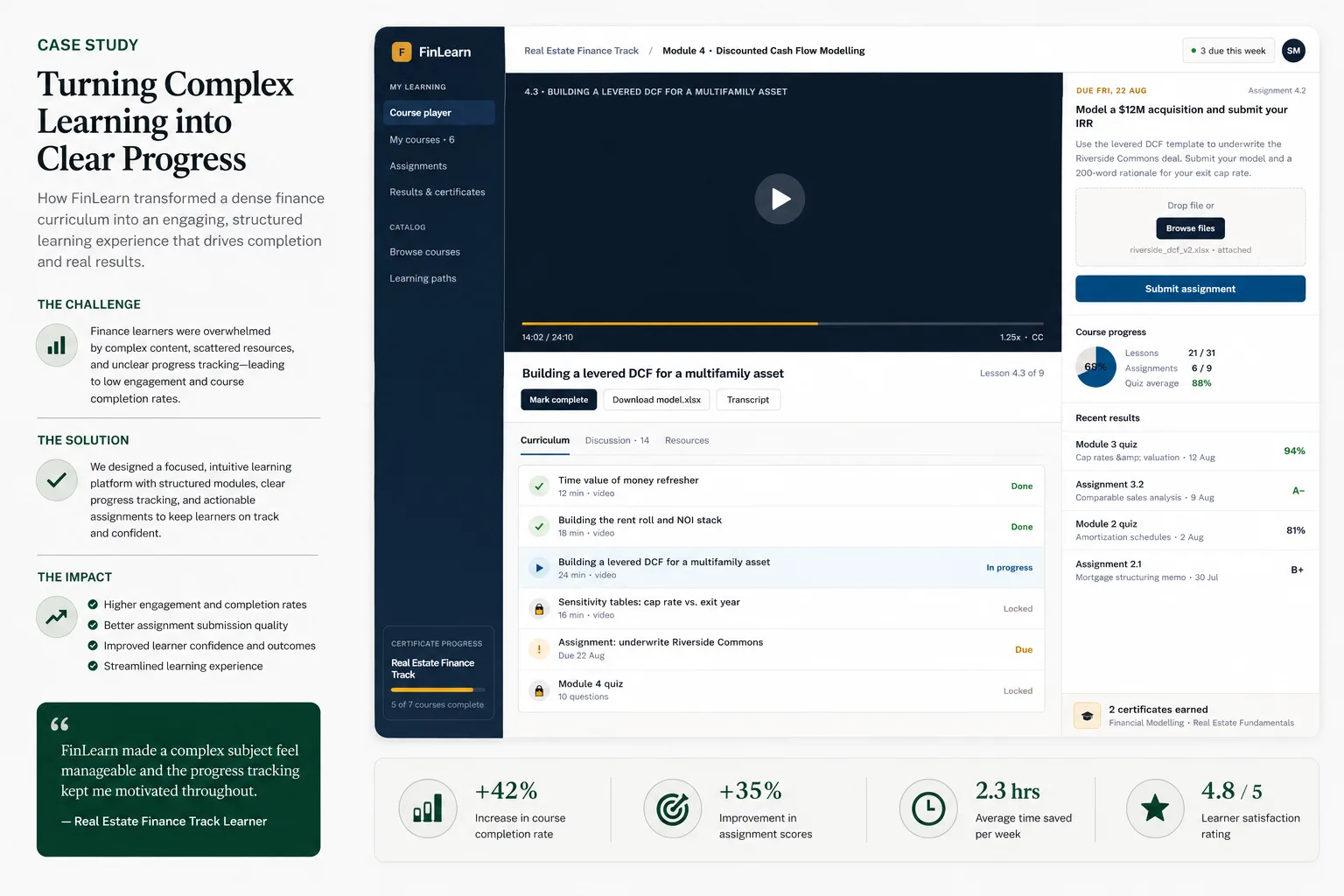
Finlearn: finance & operations academy.
Admins run cohorts in a fraction of the previous effort.
React · Django · Wagtail · PostgreSQL
 Education
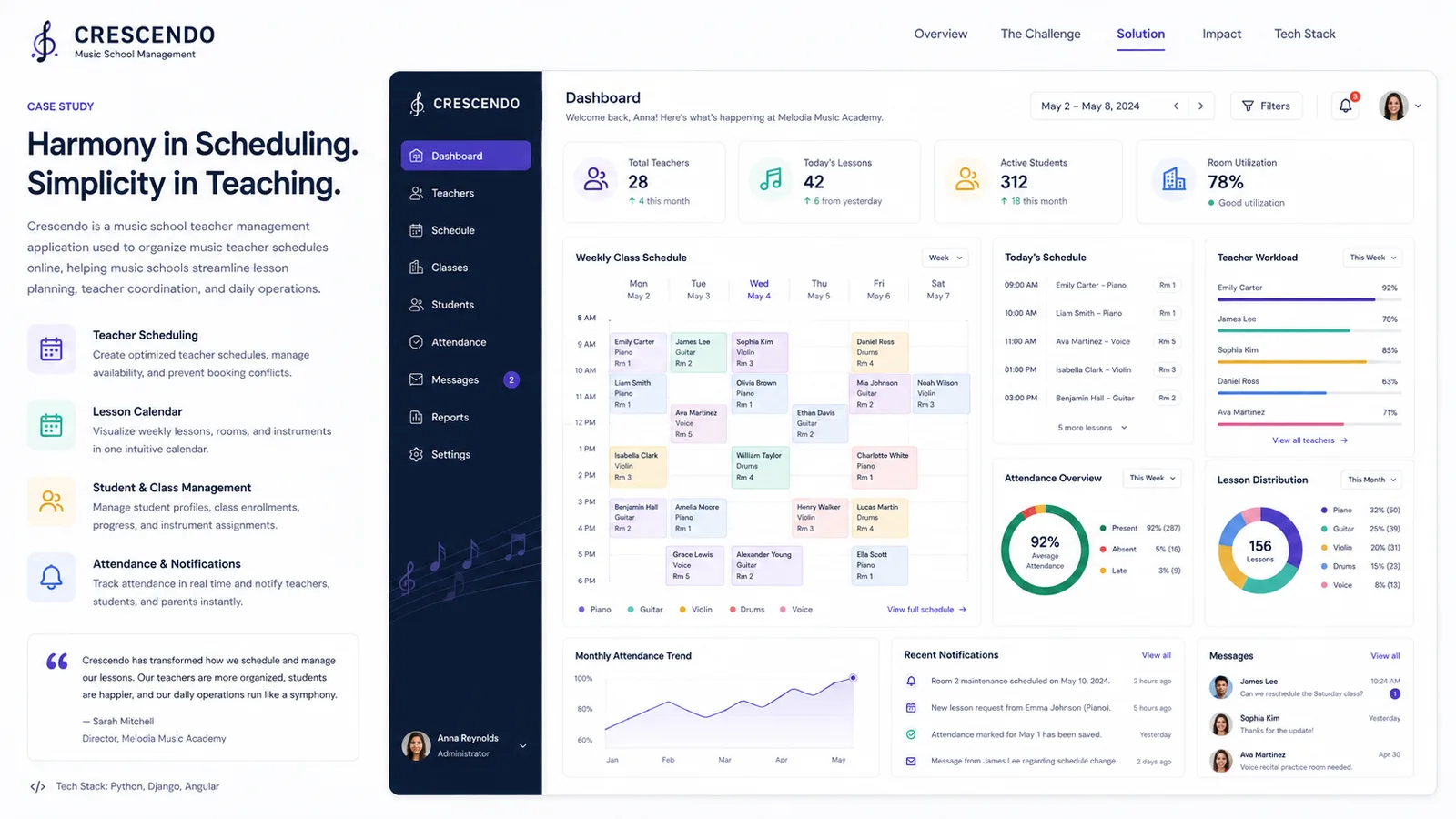
Crescendo: scheduling for a music school's teaching staff.
The timetable is maintained by the people who hold the information rather than relayed to an administrator.
Angular · Django · Python
 Education
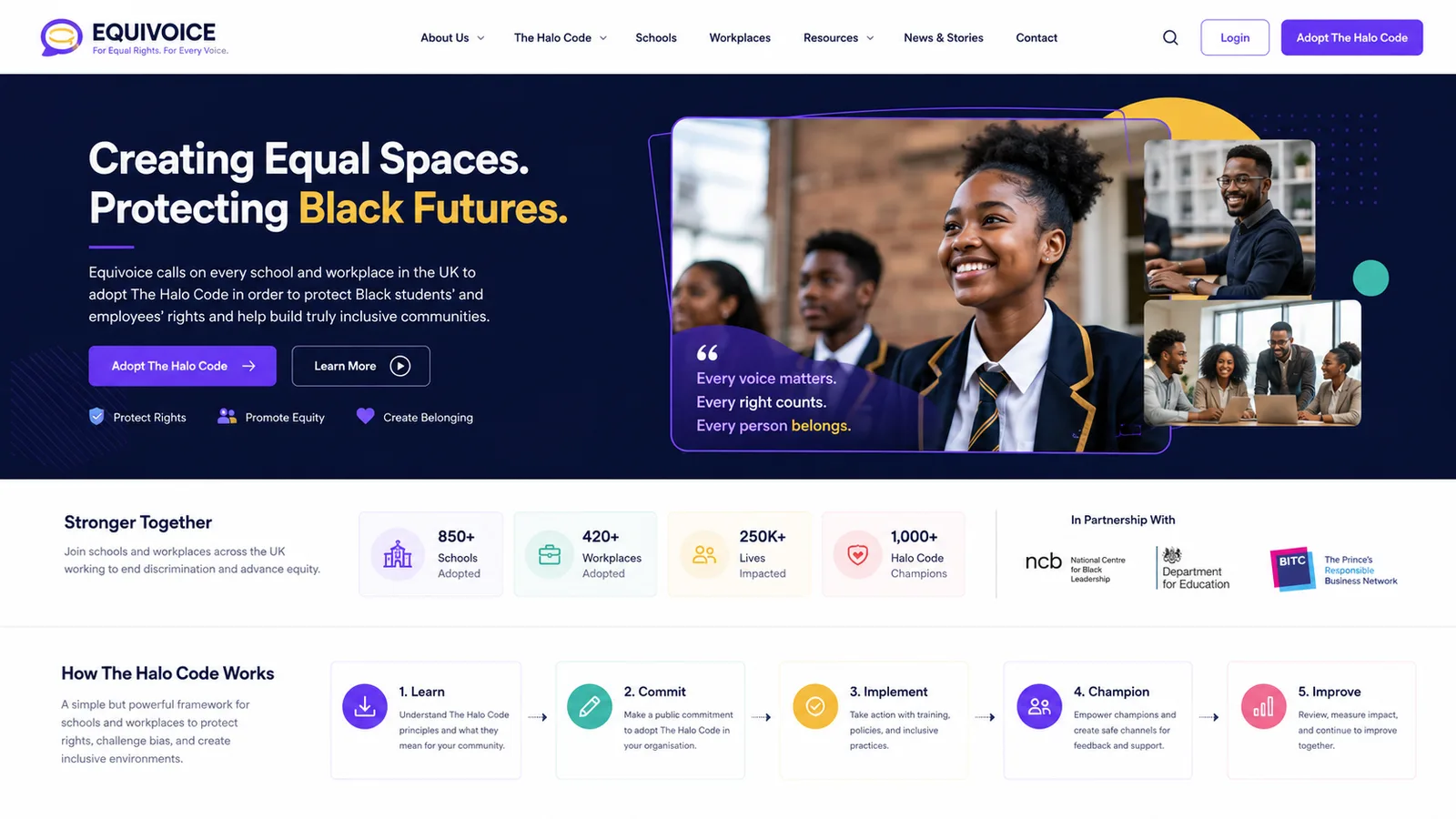
Equivoice: Education platform.
A web app for online learning, built with Wagtail, AWS, Python and AWS SES. Courses, submissions, grading and progress live in one platform that learners return to and instructors run without technical help.
Wagtail · AWS · Python · AWS SES
Where AI fits in education.
Tutoring assistants grounded in your course material, feedback drafts that teachers review before release, and course content generated to your curriculum.
Explore AI development“Dragonfly has been working with the team at Enigmatix Global for several years now on building out our web-based platform and APIs. One of their strengths is quickly building out a multi-disciplinary team to work on the development and delivery of features with different technical requirements. Their support has allowed us to accelerate our development work without building an internal team. They have also worked seamlessly with other third parties both during the acquisition of Dragonfly and development of our mobile app. Enigmatix Global has been instrumental in bringing our ideas to life and providing guidance to help us make the best technical decisions. I would recommend getting in touch with them if you're looking for support.”
Questions about this build.
Still wondering something? Ask an engineer
Put the rules on the server and model the exercise as a sequence of decisions against a changing state. That gives you two things worth having: participants cannot inspect or shortcut the scenario, and educators can revise it without an app release. It also makes the outcome explainable — you can show which earlier decision produced the situation someone ended up in, which is where the actual learning happens.
Ideally by not holding it. An education or simulation product rarely needs real account data to work, and scoping it out removes an entire category of risk rather than mitigating it. Where genuine member data is required, it stays with the institution's existing systems under their controls, and the education app holds a reference rather than a copy.
Cross-platform suits this kind of product well, which is why this one uses React Native. The interactions are forms, progression and content presentation, none of which need platform-specific implementations, and a single codebase matters more than usual when the app is used in facilitated sessions where a mixed room of devices must behave identically.
Yes, and it should be a requirement rather than an optimisation. Keeping scenario content and rules server-side means the people who own the material can revise it on their own timeline instead of queueing behind app store review. The design decision that enables this is drawing the line early between what is content and what is code, because retrofitting that split is expensive.
Let's build from here.
Thirty minutes with an engineer who builds. No sales, no drip campaign. If we're the wrong fit we'll tell you and point you somewhere better.